[硬球] Knuckleballers unite
http://www.hardballtimes.com/main/article/knuckleballers-unite/
Knuckleballers unite
by Josh Kalk August 19, 2008
"I always thought the knuckleball was the easiest pitch to catch. Wait till it
stops rolling, then go to the backstop and pick it up." - Bob Uecker
Quick, name all the pitchers who have thrown a knuckleball in the majors in the
past two years? I'll even give you a hint: There are five.
Stumped? Okay, here is the full list: Tim Wakefield, Charlie Zink, R.A. Dickey,
Charlie Haeger and Josh Banks. Pat yourself on the back if you got all five.
Now, Zink and Haeger have spent only brief time in the majors and Banks doesn't
use the knuckleball as his main pitch, but anyone who says that the knuckleball
is a lost art or is dying out is just flat wrong. The knuckleball is alive and
well and now that PITCHf/x is on the scene we have a chance to look at a real
sample of knuckleballers and see how each uses the pitch.
Of course, the most famous current knuckleballer is Tim Wakefield, and John
Walsh already has done a tremendous job of breaking down Wakefield's
knuckleball, so I will not be adding too much about him. What I want to do is
to compare Wakefield's gold standard to the other knuckleballers and see how
they match up. Who throws the second best knuckleball and how close to
Wakefield does he get? To answer this, of course, we are going to have to
quantify what makes a good knuckleball. For that, we will start with Wakefield.
Tim Wakefield
Normally when I talk about a pitcher's stuff, I say things like his average
fastball is 92 mph with five inches of horizontal movement and 10 inches of
vertical movement. Talk like that doesn't make a lot of sense when describing
knuckleball because the beauty of pitch is it sometimes will move down and in
and other times will move up and away. So when you average the knuckleballs
together, you get something like a 65 mph pitch with two inches of horizontal
and vertical movement.
As John pointed out, knuckleballs that don't break get hammered (yes I am
linking to John's article on Wakefield again; if you haven't read it go skim
that section at least). This makes a lot of intuitive sense and, as John found,
it doesn't seem to matter if the ball is moving up or down or right or left—
it's just that it is moving that is important. So the goal for a knuckleballer
is to throw his knuckleballs with as much spread as possible (within reason).
Mathematically, we can measure that by looking at the standard deviation of
each pitcher's knuckleballs. The higher the standard deviation, the better the
knuckleball is. Wakefield has a standard deviation of 5.6 inches horizontally
and 5.4 inches vertically on his knuckleballs for a total standard deviation of
7.8 inches. Because the horizontal and vertical spread is very similar for all
current knuckleballers, from now on I will report only the total spread. This
puts Wakefield as the leader in the clubhouse; now, how do our other
knuckleballers match up?
R.A. Dickey
Dickey is a 33-year-old who has been bouncing around baseball for years now. He
spent several years with Texas before catching on with the Brewers' Triple-A
team last year and signed with Seattle in the offseason. Dickey got off to an
excellent start in Tacoma this year and has been up and down for the Mariners,
working both as a starter and a reliever.
Dickey's fastball is actually a sinker that he throws in the mid-80s and bores
in quite a bit against right-handed batters. Dickey throws his sinker about 27
percent of the time, which is a lot compared to Wakefield, who throws his
fastball at about 18 percent. Dickey's knuckleball is also faster than
Wakefield's, in the low 70s, and he has a total standard deviation of 5.8
inches with his knuckleball. Unlike Wakefield, who also throws a curve, Dickey
throws only a sinker and a knuckleball.
Here is what his movement chart looks like.
http://www.hardballtimes.com/images/uploads/R.A_._Dickey_.gif

Charlie Haeger
Haeger has been a farmhand for the White Sox since 2001, when he was drafted in
the 25th round. He got a cup of coffee with Chicago in 2006 and then an
eight-game trial at the end of the 2007 season. He has pitched well in the
minors the last few years and is only 24, so he could have a long future ahead
of him. Like Dickey, Haeger throws just two pitches, though his fastball is a
four seamer around 84 mph. PITCHf/x got to track only 101 pitches for Haeger
last year, with 20 of them being fastballs and the other 81 knuckleballs, so
the statistics for him are rather slim. His knuckleball is in the upper 60s and
his standard deviation is 6.5 inches.
Here is Haeger's movement chart.
http://www.hardballtimes.com/images/uploads/Charlie_Haeger.gif

Charlie Zink
Zink was a hot prospect a few years back but he has fallen on hard times
recently. Zink is 28 now and was having a much better year at Triple-A this
year before getting a call-up to replace Wakefield in the Red Sox rotation. I
don't have to remind you how that turned out. Again we have some small
statistics for Zink with only 60 knuckleballs to look at. Zink's fastball is in
the low 80s, with a slider in the upper 70s and his knuckleball right around 70
mph. His knuckleball has a total standard deviation of 5.7 inches.
Here is his movement chart.
http://www.hardballtimes.com/images/uploads/Charlie_Zink.gif

Josh Banks
Banks is an extremely interesting pitcher whom I plan to profile soon. Banks
only occasionally throws a knuckleball, as did Tom Candiotti. The knuckleball
is a small part of a huge eight-pitch arsenal for Banks. You might be wondering
how the catcher signals for all those pitches and it turns out he has an
interesting method. Like Haeger, Banks is just a pup, turning 25 this year, and
also like Haeger, Banks has had solid success in the minors the past few years.
I can find seven of the eight pitches he claims to throw (being just a second
change-up short) but it is possible that he scrapped one of his change-ups as
the articles I linked to are all from preseason. In any case, today we are
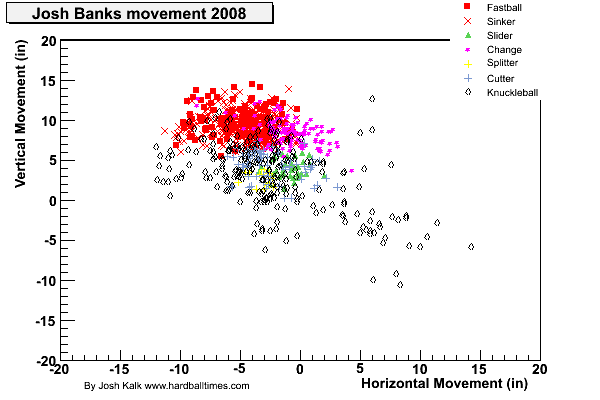
interested in Banks' knuckleball, which is actually a little hard to pull out
from his splitter. After some work we can find that he throws the pitch about
22 percent of the time, more to lefties than righties, and he averages 6.6
inches of movement with the pitch. What is really remarkable is that he
generates that movement with a hard knuckleball, like Dickey's, in the mid 70s
and can manage that while topping out in the low 90s with his fastball.
Here is a look at his terribly messy movement chart. You can see how he is all
over the place with his pitches, but for now try to focus on the knuckleball.
http://www.hardballtimes.com/images/uploads/Josh_Banks.gif
Conclusions
The knuckleball is alive and well in majors, with not only a handful of
pitchers plying the trade but several young pitchers who should still be on
their way up. As expected, Wakefield remains the king of the knuckleball with
the highest spread when he throws, it but Banks and Haeger aren't too far
behind. Banks claims he can throw a slow knuckleball like Wakefield and it is
possible he could get Wakefield-like movement with that pitch, since he already
is getting a ton of movement on his hard knuckleball.
If you are a fan of pure knuckleballs, then Haeger is probably the guy you want
to be rooting for. He is the youngest of the bunch, and the knuckleball is his
main pitch. Banks, though, is the most likely pitcher to stick, so if you don't
mind seeing some conventional pitches (and he has quite an array of them) tune
in next time he takes the mound.
they probably need to be successful in the big leagues. Also, neither exactly
has been lighting up the minors consistently, so that seems like another strike
against them.
--
※ 發信站: 批踢踢實業坊(ptt.cc)
◆ From: 118.160.68.192
推
08/20 20:29, , 1F
08/20 20:29, 1F
推
08/20 23:27, , 2F
08/20 23:27, 2F
RedSox 近期熱門文章
PTT體育區 即時熱門文章
36
50